Reading too deeply into these things since 1981
Header


It’s finally happened…Denver has Moonrise Kingdom. And while I’m sure it will take me several more viewings to really formulate a thorough opinion, I can confidently say this much: it was worth waiting for.

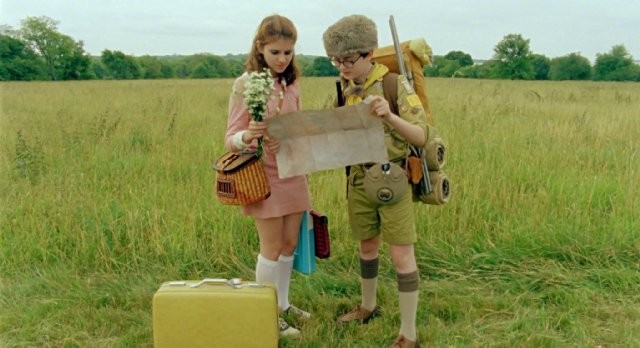
The plot, as everybody knows by now, is that two lonesome youngsters named Sam and Suzy fall in love and take off together, as a massive storm brews and the small town becomes increasingly desperate to find them. Because I’d like to keep this review relatively spoiler free, I won’t say much more than that. I do say “relatively,” though, so if you’d like to remain totally unspoiled, stop reading now…and just know that, yes, it’s a film worth experiencing.

Moonrise Kingdom is a strange film…it both feels like a Wes Anderson film and yet stands pretty uniquely among them. Part of this might be due to the fact that he focused the film completely on a pair of unknowns — the first time he’s done that since Bottle Rocket — and sidelined the few regular collaborators that do appear. This movie very distinctly belongs to Sam and Suzy…and that does leave me with mixed emotions, though they are almost uniformly positive.

The two young actors — Jared Gilman and Kara Hayward — are each fantastic finds. Gilman in particular does an excellent job of portraying Sam as a young man who’s not necessarily wise beyond his years, but certainly troubled beyond them. He’s guileless and without any sort of malice whatsoever…which is both why he becomes an easy target to his fellow scouts, and eventually earns their sympathy.

Hayward’s work here is much more subtle — especially as her more manic moments all occur offscreen, thanks to some artful editing — but ultimately Suzy comes across as someone who alternates seamlessly and immediately between frightened and frightening.

Between them, the two leads do most of the emotional heavy lifting…though it’s almost as though Anderson doesn’t quite trust them to handle the load (more on that later). Regardless, Moonrise Kingdom contains its expected share of painful exchanges, revealing character not by what they say and do, but by what they fail to say and restrict themselves from doing.

One particularly intelligent choice on Anderson’s part was to provide us with information that each of these children, separately, is seen by others as being emotionally disturbed. The intelligent choice is to actually bear that out in how they act and react in their various adventures; this isn’t a case of adults failing to understand their children…this is a case of adults correctly assessing the fact that their children have problems, but not knowing how to handle them.

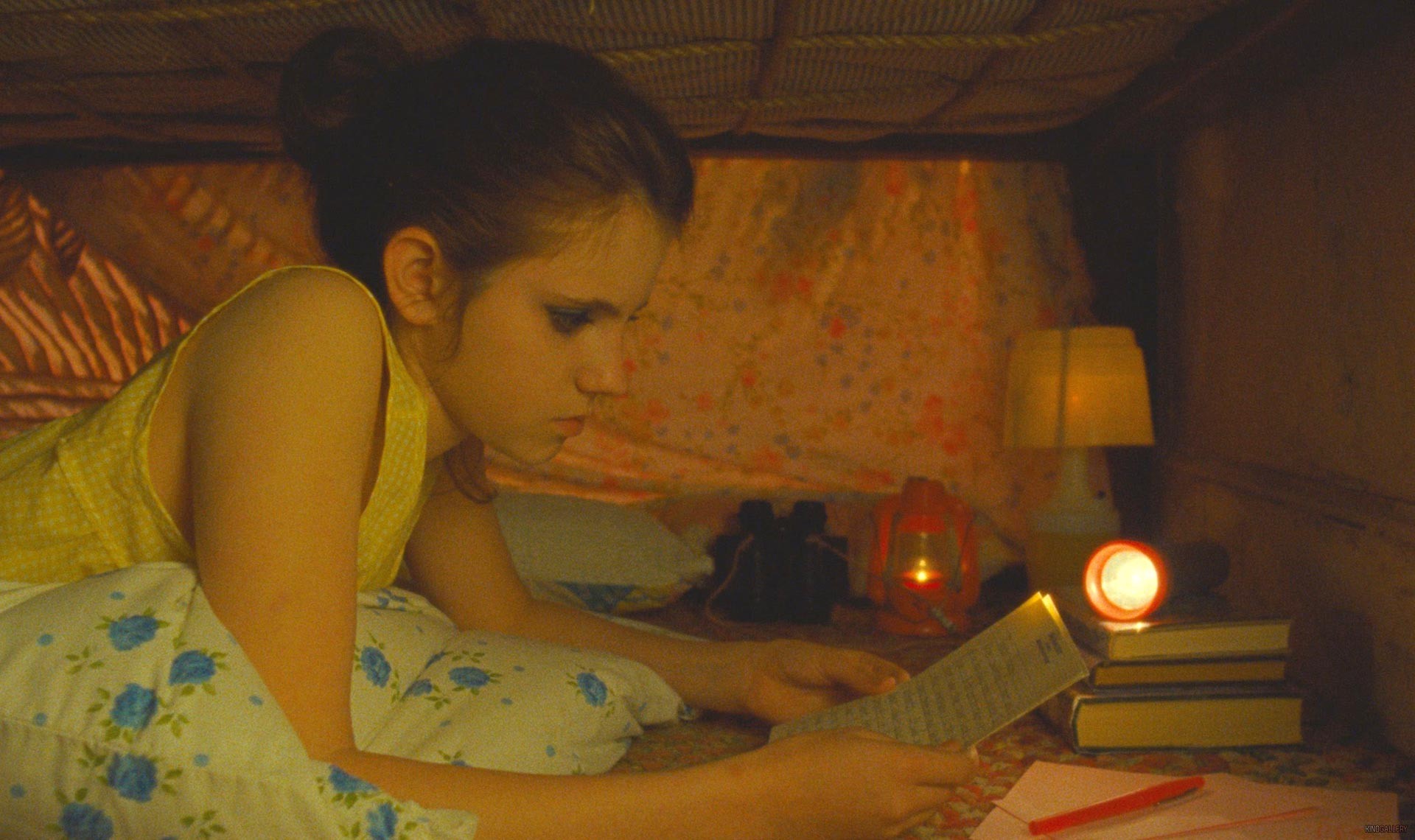
Suzy, for example, is prone to violent outbursts. It’s completely at odds with her conservative dress and meticulously composed hair and makeup, but it’s always there in her eyes…a lurking, relentless darkness that prevents her from ever feeling at ease. One of Hayward’s best scenes in the film is one in which we can’t hear her…an outburst at her family in the middle of dinner. We catch her in mid eruption, and though we can’t hear a word she’s saying, that’s not important. What’s important is that she can’t contain her anger — which may or may not even have definition — and also that her family sits quietly, absorbing it, not reacting. They don’t know how to handle their daughter…and therefore cannot help her.

Sam’s issues are rooted a little more deeply, and are therefore that much more obscured. He is an orphan who has not recovered from the deaths of his parents, and he wears his mother’s brooch like an exposed scar. At one point he confesses to having committed arson while sleepwalking…and he got in trouble for it because nobody believed he was actually asleep. What neither Sam nor Suzy understands is that it doesn’t matter whether or not he was asleep…either way, he needs help that is not being offered to him.

But the two understand each other, and the two accept each other, and those are things that neither has ever really felt they’ve had before. They each come burdened with baggage, but they’re not judgmental of each other. In fact, Sam takes great pains to transport all of Suzy’s overloaded luggage along with them, regardless of the trouble it causes him to do so. In a clever inversion of the moral of The Darjeeling Limited, which requires each of the brothers to leave their accumulated baggage behind, Sam embraces Suzy’s, understands that that’s who she is, and is always careful to let her know that he’s comfortable with that.

Of course, the two are each living in a fantasy of their own devising. Why this works, however, and why we root for them, is that these fantasies are compatible. Suzy wishes to be swept away, and Sam wishes to sweep away. It gets them each where they think they need to be, and it’s a seductive combination. As short-sighted as their plan really is (tellingly, Suzy only borrows her brother’s record player for 10 days), we want this for them. After all…what else do they have?

One line that many reviewers seem to latch onto as a pretty clear distillation of the film is what Sam says to Suzy when she tells him she’s envious of the fact that his parents are dead. “I love you,” he says, “but you don’t know what you’re talking about.”

Personally, I think the defining moment came for me when, early in the film, Suzy asks about a recently deceased dog that Sam used to know. “Was he a good dog?” she asks. Sam, more sagely than he realizes, replies, “Who’s to say?”

It’s a very Anderson-like response, tapping into very Anderson-like themes. Who is to say? We all view ourselves in some way, but, if that’s not what the world sees, then what does it matter? Who are we? Are we the people we try to be? Or are we the people everyone else believes us to be? What are we? What defines our identities? Or, to phrase it in the parlance of this film, what kinds of birds are we?

Moonrise Kingdom catches the protagonists at a pivotal point in their lives, during which the promise of a magical future has yet to die and become the lingering echo that haunts the Tenenbaum family, or Team Zissou. For Sam and Suzy, whatever the future may actually turn out to hold, there is still time.

For the other characters in the film, there’s less time. The major adult characters are resigned to their roles, to their failings, and to their fates. Bill Murray’s character expresses exactly one wish in the film, and that’s for the storm to pull the roof from his house and suck him into space, because his family would be better off without him. It’s a fantastic line perfectly delivered, and it conveys a concentrated lifetime’s worth of disappointment.

There’s more I could say about this film. Maybe, eventually, I will. But, for now, I’ll move on to the very small complaints I think I have after one viewing, which will likely be totally erased after another few, if history is any example.

For starters, this is absolutely Anderson’s most overtly comic film. Jokes and sight gags are packed into these scenes, and they often dominate. It’s not a bad approach, but it’s certainly somewhat jarring for Anderson to be chasing the more obvious laughs, and I almost wonder if it’s because he didn’t trust his young leads to handle the emotion on their own. By undercutting himself and giving the audience a chance to relax into a more comfortable form of humor, he is lightening the loads that his protagonists actually have to carry. It’s a noticeably unrestrained variation on his typical approach, and while I don’t think it hurt the impact of the film, it did seem to make it feel unfocused at times.

Also, I’m not entirely sure that any characters outside of Sam and Suzy experienced any clear growth. The film suggests that they did, or at least that some of them did, but it would have been nice to spend more time with them along the way, and perhaps come to understand precisely how they’ve changed, and exactly why that’s important. Then again, as my girlfriend correctly put it, Anderson isn’t one to dwell on information he doesn’t think we need, and we, as members of the audience, should be meeting him at least halfway. For now, however, after one viewing, I feel as though Captain Sharp and Scoutmaster Ward had their most impressive moments when the cameras weren’t on them.

Overall, though, I loved it. At the end of the film I wasn’t sure what I thought, but by the time the credits ended I was already cycling through dozens of conflicting emotions, and I still am right now, as I write this. Moonrise Kingdom left a mark. I don’t know what that mark is, just as none of the other children understood their compulsion to listen to Suzy read from her stolen library books. It’s a story, and it means something to them. They might not know what. They don’t mind. The experience of feeling it unfold is the reward.

Moonrise Kingdom unfolds in enormously satisfying ways. And it’s okay if you feel a little bit confused…young love has that effect on people.


Well, it’s come and gone. It was a lot of fun and also a lot of work, but Wes Anderson Month is over. When I first announced this project, I pretty much expected to fail at some point and not have time to write everything I hoped to write.

Shocking the hell out of me, I actually delivered on every one of my promised features, and even had the chance to post a few more.

We had…
- Friday Musical Interludes of “Here Comes My Baby” by Cat Stevens (Rushmore), “30 Century Man” by Scott Walker (The Life Aquatic With Steve Zissou), “Les Champs-Élysées” by Joe Dassin (The Darjeeling Limited), “Let Her Dance” by The Bobby Fuller Four (Fantastic Mr. Fox), and “Zorro is Back” by Oliver Onions (Bottle Rocket).
- A Fun Deconstruction of the Moonrise Kingdom trailer.
- An Admittedly Biased look back at Wes Anderson’s films to date.
- A Revised Version of my 10 Most Affecting Wes Anderson Moments article.
- A Direct Response to reader David Black, who wondered whether or not Anderson’s obtrusive hallmarks might prevent his films from achieving greatness.
- …To Which Dave Responded with a defense of Fantastic Mr. Fox.
- We Compared the handling of cross-cultural romance between Bottle Rocket and The Darjeeling Limited, and had no difficulty determining which was more successful.
- We Spotlighted Anderson’s rightly adored coming-of-age tale Rushmore, and explored its hands and handiwork.
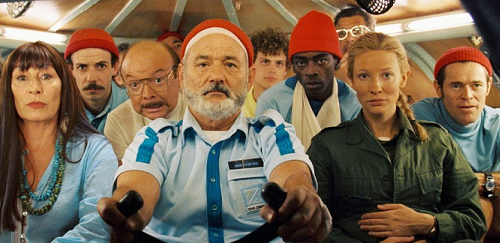
- We Deconstructed a Scene from the criminally under-appreciated The Life Aquatic With Steve Zissou, which we think makes us Blue Star Cadets by default. He’ll send us a red cap and a Speedo.
- And Finally we defended Anderson’s voice, and his desire to stay true to it. Some see it as a refusal to evolve. Whether or not that’s true, we’re perfectly happy where we are.

…alright, alright. I admit, I did not fulfill all of my promises. The month was meant to culminate in my review of Moonrise Kingdom, but — of course — it’s not playing anywhere near me. At all.

So thanks for sticking with me through this, and for being on-hand to revel in my inevitable disappointment.

We’ll resume regular noiseless chattering immediately.

See you after the movie.


Oliver Onions, “Zorro is Back”
Zorro Original Soundtrack, 1975

And so Wes Anderson month draws to a close, as Moonrise Kingdom lingers hesitantly upon the horizon for another couple of days, and we conclude our month-long reflection on that which has come before.

This, however, is not meant to be a particularly thought provoking piece. It’s not what you will remember — if you remember anything at all — and it’s not going to make any grand and conclusive statement. It’s just a final thought before we move forward, before Wes Anderson officially has another release under his belt, and before Moonrise Kingdom takes its rightful place beside his other films, so that we can wait expectantly again for rumors of the next.

It’s a piece, or, perhaps, a tribute, dedicated to the strong relationship between one man and his voice. Because that, without question, is Anderson’s greatest strength, and it’s what his biggest fans see when they react so strongly to his work. It’s also what his most vehement detractors see, though they might not realize that.

Anderson’s regularity in terms of his core cast, reappropriated pop songs, emotional dissonance, familial dissatisfaction, costumes, meticulous set design, original score composers and even typefaces all lead certain members of his potential audience — and certain reviewers — to deride him as somebody who is either incapable of evolution or totally opposed to it. Personally, I see all of that as evidence that Anderson found his voice quickly and firmly, and therefore sees no benefit to hollow deviation.

I wouldn’t see a benefit either. Evolution, in an artistic sense, should never occur for its own sake. An artist must always be evolving toward something, not in a state of constant flux. For an artist, comfort is paramount. That’s when artists are free to realize their visions. The less an artist has to worry about the relatively minor aspects of their production, the more they can focus on crafting a compelling core experience.

Anderson has spent his (admittedly young) career surrounding himself — like Steve Zissou — with a core group that he knows he can trust to realize smaller aspects of his vision. With those team members in place, he can focus on what the production is. It frees him to make decisions he might not otherwise have the time to get to.

The films of Wes Anderson don’t represent a refusal to evolve…they represent a confidence of vision. Anderson knows his own hallmarks; he’s not deaf to what critics say and he’s certainly aware of the amount of money each of his films takes in. (Or, of course, fails to take in.)

But he’s an artist, not a businessman. He knows that a commitment to his strengths are what will benefit him — and his audiences, even if it takes them a while to understand that — in the long run. His place in film history won’t be reserved for a man who shapes himself differently with every film in a doomed attempt to satisfy a fickle audience. No, his legacy will be a sturdy one, rooted in a single spot…because it just so happened that he found his calling almost immediately.

Many artists search their entire lives for a voice. Those artists have a need to evolve. Along the way they attempt different things, shed what doesn’t work, and glide — hopefully — toward a strong foundation of what does. From that framework, their experiments benefit from confidence, from understanding, and from the sheer satisfaction of having found it.

Wes Anderson was fortunate enough that he didn’t have to look very far. To put it another — equally accurate — way, we are fortunate that he didn’t have to look very far.

He has a lifetime of creativity ahead of him, and the luxury of already knowing how to say whatever it is he’ll need to say next.

I don’t need Anderson to pen a straight romantic comedy, or a detective story, or a historical drama just to prove that he can. Because that wouldn’t be him. That wouldn’t be his heart, those wouldn’t be his words, and that wouldn’t reflect his vision.

I don’t want Anderson to change. I want Anderson to continue to grow. In other words, I want Anderson.

Oftentimes, growth lies inward.

Anderson’s characters know that. Anderson knows it too.

And somehow, I already know that Moonrise Kingdom is going to be derided by many as being “more of the same.”

That’s okay. From a distance, it all looks like the same color.

To those willing to come a little closer, however, Anderson’s painting with a wealth of different shades.

This is an adventure.


The Life Aquatic With Steve Zissou is a strange film. It’s about family, it’s about celebrity, it’s about revenge, and it’s — arguably primarily — about the relentless intrusion of reality into a life carefully cultivated. It’s many things throughout the course of its runtime, and it’s never less than two distinct things at once. It is, I would argue, one of Anderson’s densest films, and it’s also my personal favorite, making it a perfect candidate for my first installment of Anatomy of a Scene.

Originally I wanted to do the Maddox Hill Cemetery scene from The Royal Tenenbaums — and there’s no reason I can’t do that later — but for the time being I think it got a fair enough bit of attention in my 10 Most Affecting Wes Anderson Moments feature. Instead I’m turning to the Loquasto International Film Festival scene from The Life Aquatic With Steve Zissou. It’s a very early sequence in the film that really shows Anderson — and Mothersbaugh, and Murray — at their indirect best. Every line and detail hearkens forward to what’s to come, making it a brilliantly constructed overture of sorts, and yet, viewed out of context, it functions perfectly well as a piece of work unto itself, standing alone as a series of emotional triggers for one man who is having a terrible night…and being required to suffer in public.
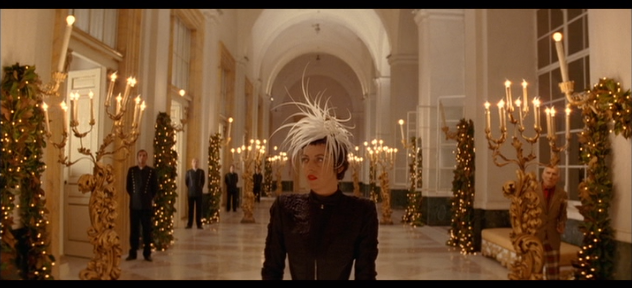
Celebrity oceanographer / documentarian Steve Zissou has just premiered his latest and most tragic film to an audience that responds with a distinct lack of interest. Steve emerges from a post-screening Q&A session that has gone no better, and that’s where the scene begins. We open on a vast and relatively empty hall, where Antonia Cook (played by the late Isabella Blow) is standing stock-still and dead center, waiting for Steve to come through the door so that she can compliment him on his film — which we can pretty safely assume she wasn’t in the room to see. She’s more interested in awaiting her chance to flank a celebrity than she is in actually watching the films that made him famous in the first place. It’s a sort of only-half-aware posturing, an appreciation of celebrity without consideration for actual merit, that Steve himself suffers from as well.

In the background we can also see the old man who will later ask Steve for his autograph; he can actually be glimpsed several times throughout this sequence before he gets his moment, suggesting that Steve has overlooked him, and, indeed, overlooks as many people as he can afford to, preferring isolation even during this grand event. When the old man eventually does get his chance, he needs to be introduced by Vladimir Wolodarsky, Team Zissou’s physicist / original score composer. As we’ll see later in the film, it really is up to Team Zissou to keep their captain grounded, and rooted to the world beneath him…if not exactly to reality.

The name “Loquasto International Film Festival” is also loaded, making oblique reference to Santo Loquasto, a famous production designer who worked on more than 60 Broadway shows, as well as many Woody Allen films — netting him several Academy Awards for his work with that great director. In short, it’s a film festival named for a production designer rather than a director, a writer, or an actor. It passively highlights the importance of design, of construction, of careful assembly…over, say, quality. That’s Steve Zissou’s world in a nutshell.
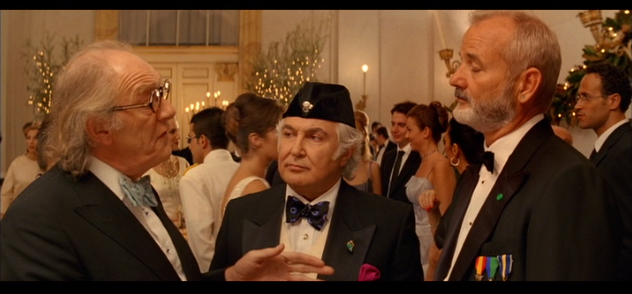
After Antonia, Steve meets with Oseary Drakoulias, head of the financially-questionable production company that publishes his films. Oseary is speaking with Larry Amin, ostensibly casually, but as Steve correctly intuits, Oseary is both flirting with Amin and angling for money. In more controlled circumstances, Steve might shake hands and move along, but after having to field questions about his closest friend’s death he’s not interested in glad-handing. Oseary immediately berates Steve for his insensitive — though accurate — response to the situation, and this berating doesn’t seem to affect Steve at all. He’s feeling as low as he’s ever been, with Esteban’s death just the latest addition to a massive stack of tragedies he’s never gotten around to dealing with.

We should take a moment to talk about the score before we get too far ahead, and feel free to listen to it in isolation from the scene. It’s a genuine Mothersbaugh masterpiece, holding true to its main theme but allowing itself to drift away periodically, before a crash of strings to pulls it back down to Earth. This piece of music is similar in that regard to Mothersbaugh’s “Sonata for Cello & Piano in F Minor” from The Royal Tenenbaums, and this scene serves a similar purpose to that one in Anderson’s previous film as well. Both scenes show us where the characters are now, in present day, plying us with the basic information we’ll need in order to interpret everything that comes next.

I’d argue that both this scene and this piece of music represent a step forward in artistic merit, however, as the earlier scene relied on narrator Alec Baldwin to keep us focused and attentive to the right details, whereas this scene dumps us disoriented into the great hall, just as Steve is dumped, and requires us to make our way, without assistance, through the onslaught of characters, dynamics, and emotions on display. The score, likewise, has a more organic momentum to its digressions than “Sonata,” what with its abrupt drum solos and reggae breaks.
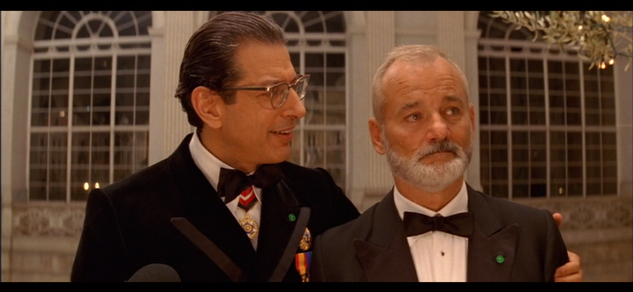
Steve’s next stop is a photo op with his “nemesis,” Alistair Hennessey (played with gleeful condescension by Jeff Goldblum). Hennessey is, as the film will both now and later prove, exactly what Steve is not: collected, well organized, efficient, and flush with cash. He also used to be married to Eleanor Zissou, Steve’s wife. We see the differences immediately upon Hennessey’s arrival in this scene: he’s smiling, he’s shaking hands, and he’s thronged by reporters. He’s in his element — unlike Steve, who is quite clearly a fish out of water…so to speak… — and this is what he lives for. He’s also — it’s important to note — clutching an award.

He makes friendly overtures toward Steve — even though they’re at least passively adversarial. He repeatedly opens the door to conversation and attempts to engage Steve while the cameras flash all around them, but Steve won’t so much as look at him or smile for the photographers. In fact, Steve doesn’t smile once throughout this entire long scene, slipping instead to varying depths of desperation and dissatisfaction. And that’s the difference between Steve and Hennessey: Hennessey is satisfied with who — and where — he is. He can afford to humorously prod Steve about his film, both because he’s happy with who he is, and because he knows Steve is not. These are two old hands in the same industry, but Steve won’t even give Hennessey a straight answer when he asks the simple — and valid — question of whether or not the jaguar shark even exists.

It’s also worth drawing attention to the Christmas decorations, which sporadically populate the hall. While The Life Aquatic contains no explicit references to Christmas, it does, in several ways, have Christmas in its blood. For starters, it was released in theaters on Christmas Day in 2004. It stars Bill Murray, who can number among his most famous films Scrooged, which is a humorous adaptation of A Christmas Carol. The Life Aquatic also deliberately echoes one of the most famous images in A Christmas Carol by ending the film with Steve hoisting Klaus’s nephew onto his shoulders like Tiny Tim. In fact, the entire sequence at the Loquasto International Film Festival functions in a thematically similar way to the first phase of Scrooge’s rehabilitation: uncomfortable — and unwilling — exposure to the ghosts of the past. In fact, I’ve long wanted to write an essay about The Life Aquatic functioning as an oblique adaptation of A Christmas Carol, but that’s a project for another time…
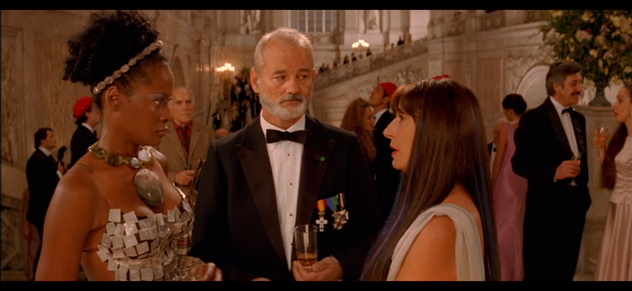
Next we meet Steve’s wife, Eleanor Zissou. As we’ll learn shortly, she is “the brains behind Team Zissou.” This is important to note, because it explains why he remains in a relationship with her. The two have a mutual dislike for each other that is only infrequently overcome by whatever tenderness survives between them, but she has the money that Steve needs to keep shooting, as well as knowing “the Latin names of all the fish and everything.”

It’s less clear why Eleanor stays with him, though. Steve is quick to point out that Hennessey isn’t much of a threat to their marriage as, in spite of his history with Eleanor, his homosexual tendencies keep him otherwise engaged. Beyond that, though, there’s less incentive for Eleanor to stay married to Steve than for Steve to stay married to Eleanor.

Once Eleanor steps away, Steve is approached by a woman — in attire suitable for a mermaid — who wishes to say hello. Steve leans in to kiss her, but she does not want to be touched by him. (It’s pretty easy to insert the word “anymore” here.) When Eleanor returns he attempts to introduce them, but Eleanor cuts him off by asking if he really wants to put her through this, resulting in both women leaving him in separate directions. Steve, alone, pops a pill.

It’s a loaded moment in many ways, and while we never see the woman again, Steve’s womanizing is absolutely to the fore several times in the future. Here it threatens his relationship with his wife, and before long it will threaten his relationship with his son.

As with everybody tonight, Steve is being exceptionally candid, confessing to Eleanor that he’s “right on the edge,” and that he doesn’t know what comes next. When both women abandon him and he swallows a pill, it’s clear that he does, in fact, know what comes next…he just really wishes he didn’t.
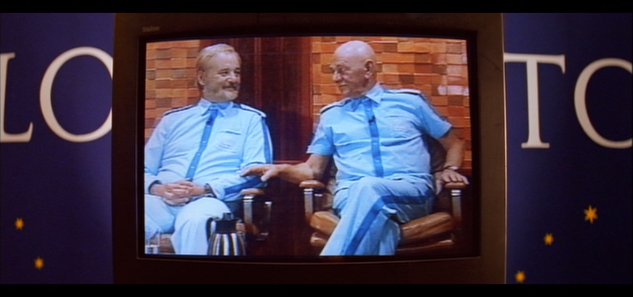
When I said earlier that Steve doesn’t smile in this scene, I was incorrect. I should have said that present-day Steve doesn’t smile in this scene, as we do see some archival footage of an early interview on the film festival’s monitors, presenting a blonde and happier Steve from better times.

The interviewer, Antonio Monda (an interestingly similar name to Antonia Cook’s), asks what Steve is to Team Zissou. Steve chuckles, but is clearly enough at a loss for a reply. Esteban places a hand on him and says, “He’s the Zissou.”

It’s exactly the kind of response that could be interpreted either way, but from Esteban, Steve hears it as a compliment. What is Steve? Esteban’s reply could suggest either that he’s everything to the team — in fact, is the team — or that he’s nothing but a name. Steve interprets it — correctly, I feel — as meaning the former. From Hennessey, it would have been the latter.

But there is no more Esteban. He’s been taken from this world and from Team Zissou by the jaguar shark and Steve’s negligence, and Steve it’s Hennessey who’s here instead. So what, now, is Steve? It’s a question our central character is going to have a lot of trouble answering over the course of them film, and it’s one to which he will go to great lengths in order avoid answering at all.

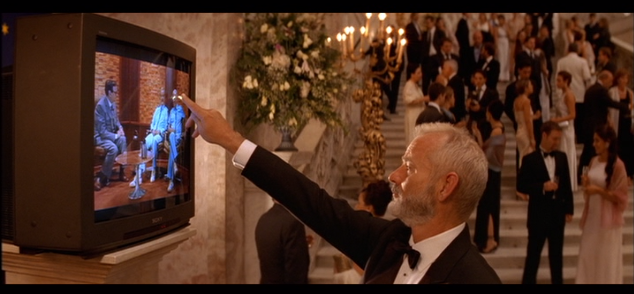
He reaches out to Esteban and a tiny spark flashes at his fingertip. Bright, urgent…and then gone. A metaphor for both Esteban himself, and also Steve’s celebrity.
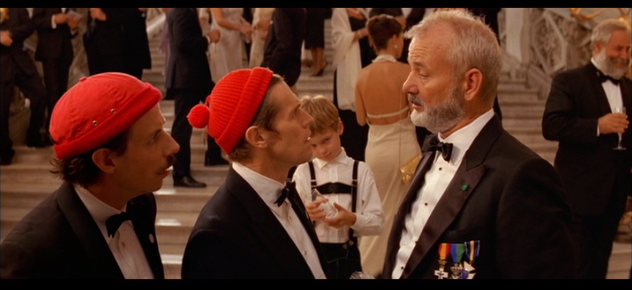
Next we meet Klaus (Willem Dafoe), who introduces Steve to his nephew. His nephew has a gift for Steve…a crayon ponyfish. It’s unlikely to be anything Steve hasn’t seen before, and it’s less likely to be anything particularly impressive — the plastic bag suggesting that Werner saved his allowance and purchased it from a pet store — but it’s a tangible reminder of Steve’s youthful ambitions. It’s an image out of his own past, an infatuation with the sea and with those who explore it. Every creature is magical, if you view it through the right lens, which in this case is the innocence of youth.

This is why Anderson created all of his sea creatures from scratch, using stop motion rather than actual, living beings. Everything is invented, and therefore everything is new to us. They need to be, so that they can stand out as magical, and not mundane. Steve’s tired and careless approach to the wondrous worlds that unfold regularly around him is a symptom of a professional and personal malaise…not any shortness of majesty in those worlds themselves. Fresh eyes like Werner’s — and implicitly ours — can still see that. Steve’s eyes are tired, but we see a flash, ever so fleeting, of admiration for the boy who admires him in return…a memory of a simpler time, when Steve really cared about what he was doing.

This is also the first time we see Steve interact with other members of Team Zissou, who, as we saw earlier in the film, don’t particularly have much experience with the sea. Their titles are telling…Steve lists camera men, sound men and script girls, but his crew is tellingly free of oceanographers and marine biologists. Instead, Steve surrounds himself with a crew that can insulate him, artificially, from the world around him. Rather than exploring and discovering the unknown, Steve prefers a life determined by scripts, lighting levels, and carefully managed interactions. He’s comfortable only when he doesn’t have to deal with the unforeseen, but it didn’t used to be this way.
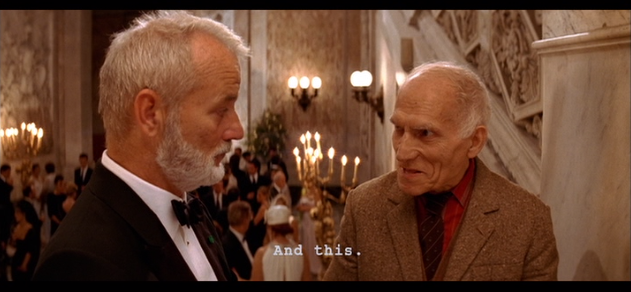
This lack of comfort is on display when he’s finally confronted by the old man in pajamas, who has come to the film festival with a stack of posters advertising Steve’s previous movies. He seeks out an autograph and at first Steve is willing to comply.

Eventually, however, Steve tells him to leave. There are too many posters to sign, and this affects Steve in precisely the opposite way that his encounter with Werner affected him moments before. (“I could go either way” is a very telling line…and, in fact, he ends up going both ways. First one, and then the other.) Here, Steve is confronted with evidence of his past. Not an idealistic reminder as he saw in Werner, but a physical, unchangeable record of what he’s actually done. The films advertised on these posters don’t strike one as being particularly good, as some of them have only the most tenuous connections to the sea at all. The old man may be a genuine fan, or he might just be a collector. Either way, he’s handed Steve a record of his professional — and progressing — degradation, and then asked him to account for every one.

It’s a disappointment that frustrates Steve and brings him immediately back down from the relative high of Werner’s gift. Meanwhile, we can imagine Klaus being particularly happy that things went so well with Steve and his nephew. As morbid as it might seem, Klaus is clearly expecting a battlefield promotion. Esteban is dead, and that’s tragic…but it also leaves a vacancy for Steve’s right hand man. Klaus has been a long-suffering and fragile member of Team Zissou, who thought of both Steve and Esteban as fathers to him. This next voyage will be his chance to step up and impress his father figure…unfortunately, this next voyage will also feature the return of Steve’s prodigal — if not necessarily actual — son Ned, which relegates Klaus again to the sidelines, and sinks him immediately into the depths of aggressive misery.

For now, however, Klaus can look forward to the future…as Steve seeks desperately to isolate himself from the past.
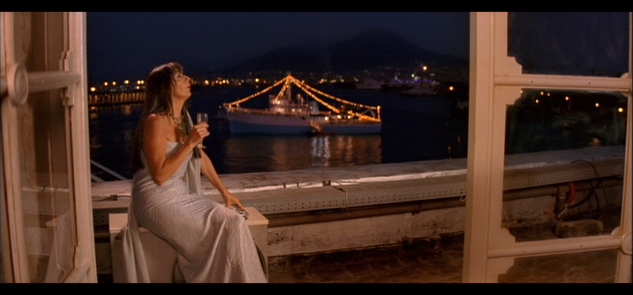
As Steve’s long, dark, wine and cheese party of the soul winds down, he finds a welcome quiet moment as he gazes longingly in Eleanor’s direction. Of course, he’s also gazing off at the Belafonte, his ship, where his life has structure, if not necessarily meaning. It’s a place where he can be safe (where, indeed, he employs a Safety Expert)…it’s the ability to set sail, and leave everything — absolutely everything — in the world behind.

For Anderson, it’s no coincidence that Eleanor is in that shot as well. After all, she’s what keeps Team Zissou afloat. He needs her, whether or not he likes her. In a remarkable bit of restrained cinematography, we linger for a short while on this view, and then return to a very long shot of Steve, silent and unmoving. He ends up being either too intimidated or too disinterested — or both — to approach his wife and speak to her, so he settles instead for raising his hand in a brief, motionless wave.

It’s impossible not to see this as well as the universal gesture for “stop.”

There’s a beautiful swell in Mothersbaugh’s score, and Steve comes back to Earth.
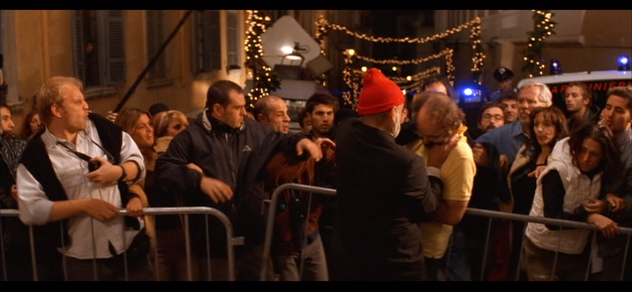
Steve’s night isn’t over yet, however, as there’s one last obstacle between him and the yearned-for safety of his boat: the crowd. Steve has no interest in any of them, any moreso than he had in the old man earlier, but one person gets his attention by suggesting loudly that Steve should be in mourning for Esteban…and then asking who he intends to kill in part two.

This is Steve’s collapse, as the weight of the evening and every conflicting emotion he’s had all night surge to his head, and he attacks the man physically.

It’s interesting that Steve doesn’t snap until after the man takes his picture (an aural “snap” itself), thus recording, yet again, another failure of Steve’s. As a celebrity, Steve must cope with his mistakes in public. He’s recognizable and famous, and as such doesn’t have the luxury of coming to terms with his shortcomings and failures in solitude.

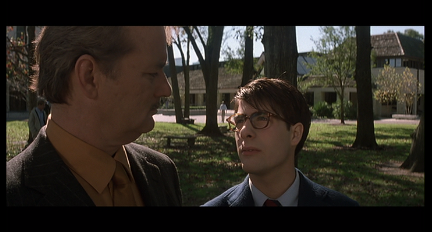
It’s interesting that in Rushmore, Bill Murray’s character also seeks refuge beneath the waterline. It’s a chance to separate, a chance to be of the world and yet also free from it. Here he must face his failings head-on, and he responds to them by lashing out.

We also see Team Zissou come to his aid not by stopping Steve or pulling him out of the fray, but by hopping the barricade and assaulting the heckler themselves. They serve as a wall — in this case literally — between Steve and the consequences of his actions. Their job is to keep their captain safe — physically, mentally, emotionally, howsoever necessary at any given time — which is why he has come to rely on them more than he’d ever be able to rely on a group of competent oceanographers.
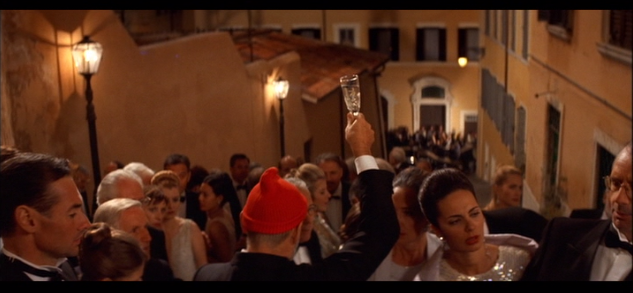
In the scuffle, the bag containing Steve’s crayon ponyfish is ruptured. While Steve would have no trouble replacing it and indeed sees more remarkable things daily, he takes a champagne glass from another partygoer and rescues the ponyfish with it, hoisting it above his head like a banner as he walks away.

But it’s not just the ponyfish he rescued — as Steve’s made clearly known, he’s not sentimental enough about sea-life to keep from killing it for personal reasons — it’s Werner’s idealism. It’s youth. It’s a message from the past, one of many he received tonight but the only one he can bear to hold onto. It’s a reminder maybe not of what Steve Zissou is but at least of why Steve Zissou is.

It’s also a small creature. Like Werner. And like Steve was once, too. It’s a creature unable to survive in the environment around him, which requires itself to be kept safe and secure until it can return to its home in the sea. Steve understands.


Pipe dreams, dad.
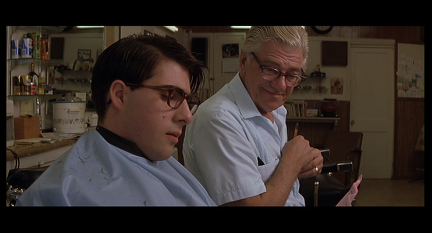
I’m a barber’s son.

When it came time for me to decide which film to spotlight for Wes Anderson month, I found it to be a pretty difficult decision. I could easily have turned to personal favorites The Royal Tenenbaums and The Life Aquatic With Steve Zissou and rattled for a few thousand words about why I think they’re great. Or I could have done a piece about why The Darjeeling Limited feels like Anderson catching himself off guard, with mixed — though ultimately excellent — results. And, of course, I could have written a piece about either Bottle Rocket or Fantastic Mr. Fox, giving myself an opportunity to explore critically my misgivings.

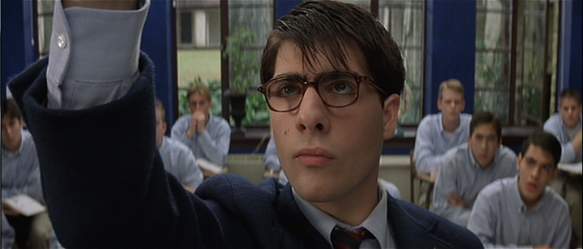
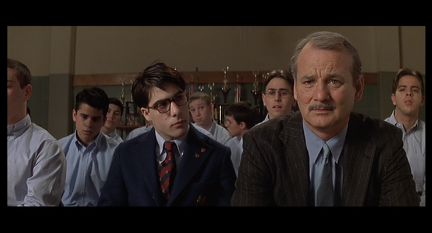
But all of that would have been almost too easy, especially when, all month long, Rushmore has been calling out to me, and attempting to instill itself in my mind as the perfect ambassador of Anderson’s form and methods. Eventually, I caved to its charm and confidence, and accepted what it told me wholesale. Rushmore positioned itself so effectively in my mind the same way Max Fischer positions himself so effectively in the film: by already believing itself to be right. That’s also how Anderson, at his best, manages not only to overcome contrived situations and wooden performances, but to harness their dormant energy and ultimately use them to his creative advantage. It’s a whole lot of charm, a larger amount of confidence, and a willingness to invest absolutely everything. Rushmore embodies all of that perfectly.

After all, Rushmore itself is a movie about manipulation, and I mean that in both the constructive and reductive senses of the word. Max Fischer is seemingly a 15-year-old omni-prodigy, though he doesn’t happen to be particularly good at anything. Or, perhaps, he’s not particularly good at anything other than manipulating people into thinking he’s good at things. It’s enormously telling — and appropriate — that the only thing that earns Max any genuine accolades throughout the course of the film is his work as a playwright.

Writing and directing plays allows him to work with his most effective resources: the tools of manipulation. Every line spoken, every step taken, every lighting decision and element of background animation are within his control, and that’s how he likes it. By default, Max is not easily shaken. Upon given notice that he’s being placed on sudden-death academic probation and may be kicked out The Rushmore Academy, he responds coolly and attempts to strike a reasonable bargain to remain enrolled. By contrast, when one of his actors fails to deliver a minor line in his stage adaptation of Serpico, Max becomes emotional, aggressive, and instigates physical violence.

Plays are where Max feels the most control, and they’re where he can rely on retaining that control. As evidence, it’s no coincidence that his assemblage of actors go under the name The Max Fischer Players. These are Max’s projects, in his hands and under his control, and if anything threatens his complete dominion over them he feels threatened, and he will lash out.

It’s also no coincidence that hands are a recurring motif in Rushmore. In fact, the film is largely — arguably entirely — about Max’s relentless manipulation of the world around him. Interestingly, the word “manipulate” itself derives from the Latin manus, which means hand. Manipulating means literally to position by hand. The word “manufacture” shares a similar original, meaning to create by hand, and both “manipulate” and “manufacture” feel like inextricable parts of Max’s daily routine. (The Latin connection is also a pleasant surprise when considering this within the context of the film.)

All of this goes to justify and explain the film’s compulsive interest in hands, and what one can do with them. Perhaps most overtly, Max lies about receiving a handjob from Mrs. Calloway, the mother of his chapel partner Dirk, which is an interestingly specific fabrication. Handjobs also factor into Dirk’s deliberately needling letter to Max later in the film, when Dirk claims he witnessed Miss Cross and Mr. Blume giving them to each other. The comedy comes from the fact that Dirk clearly doesn’t know what a handjob is — they’re rather necessarily one-sided in heterosexual relationships — but when Max believes it, he reveals that he doesn’t know either. It’s something that sounded appealing to Max, and its emphasis on handiwork — so to speak — fits in perfectly with his personal ethos, and lent itself to a thematically fitting lie.

Miss Cross also invokes the concept of a handjob when she asks Max what he’d tell his friends if they did sleep together. She also asks whether or not he’d claim that he fingered her…another clearly (and more accurately phrased) reference to his hands in a sexual sense.

Less obscenely, Max uses his hands to make statements that he cannot — or chooses to not — make through his words. He orders a construction crew to shut down by gesturing to them, he signals to a disc jockey to play a song he’s selected specially for the occasion, and he flashes Dr. Guggenheim the middle finger after starting a fire outside of his office window. For an artist, particularly one who engages regularly in strongly physical extra-curricular activities, the hand can be as expressive or more expressive than the voice. Even his handwriting is deliberately considered and executed, with a careful calligraphy employed even his least formal note taking.

Max’s hands serve as a clear symbol of who he is, and of what he does. That’s why when Dirk refuses to take his hand after a school-yard scuffle, it’s much more clearly a rejection of who Max is as a person than a simple — though loaded — refusal to help him up. Dirk eventually apologizes for not taking his hand, and Max, in the same conversation, apologizes for claiming that his mother gave him a handjob. A hand caused both insults, and an apology — pardon the phrasing — waves them away. Soon afterward Max overcomes his funk by taking the kite from Dirk and flying it himself…a physical engagement and act of control that immediately causes him to begin brainstorming a new endeavor: The Kite Flying Society, with a flood of names for potential members following close behind. It’s Max regaining control…however far removed from what he might have lost on his way down.

This unstoppable yearning for absolute control is endemic to Anderson as well, and the meticulous structuring of each of his films — starting, of course, with Rushmore — makes that clear. Like Max, there’s not a set detail that escapes his notice, or that could possibly receive too much of his consideration and attention. Like Max, he demands limitless artistic control over his actors, their wardrobes, and the soundtracks playing behind them. And, like Max, his critics would argue that in this search for clinical perfection, he misses the human element that makes these pieces of art worth creating.

The latter is a viewpoint I don’t particularly endorse, but it does mean that Anderson’s taking a sideways approach to humanity, which to some is one of his clearest hallmarks and to others is one of his most distracting tendencies. For Max, it was more a question of realizing that those around him — along with the world as it actually is, as opposed to how he wishes it to be — are beautiful in their own way, and worthy of his respect and appreciation for who they are. Max wants to see the world as a series of purposefully constructed moments marching toward a grand statement or triumph…which, it must be said, is exactly the environment Wes Anderson creates for him within the film. But, along the way, those moments reveal weakness, and a genuinely pained emotional core.

It’s not until the end of the film that Max can accept that, sometimes, we just need to take the world for what it is, and realize that while we can’t have everything we think we want, we can live a perfectly fulfilled life with what we have. His father may only be a barber, but that’s a disappointment only in the relative sense that he’s not a neurosurgeon…a fiction Max invented for the sole purpose of being taken more seriously, but which instead proves to be a painfully distinct schism between his fantasy and the real world around him.

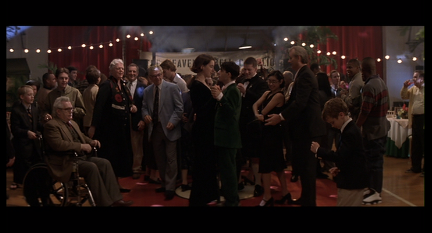
And Margaret Yang, a classmate whom he remakes into something more attractive by removing her glasses, doing her hair and dolling her up with makeup, fails to capture his fancy even after all of his meddling. When he dances with her at the end of the film and is sweetly embarrassed by the possibility that she might now be his girlfriend, it’s the real Margret that he finally embraced…not the deliberately manufactured fiction that he put on display in front of everybody. (It’s also worth noting that the character of Margaret Yang was originally intended to have a missing finger — a concept that was latter reappropriated for use in The Royal Tenenbaums but would have even further advanced this film’s manual infatuation.)

Max Fischer’s world is less a place to live than it is a stage upon which he intends to will to life a carefully shaped destiny. He cultivates the world like a gardener, pruning what doesn’t work, attending to what does, and if there’s anything missing that he really wants, he’ll go out there and plant it himself. It’s precisely the opposite of Herman Blume’s worldview, which is more akin to being trapped in a Hell of careless accumulation. He ends up married to a woman he doesn’t love, with two brutish sons he never expected to have, and he’s envious of a 15-year old boy…not because he has everything together — he’s already heard from Dr. Guggenheim what a lousy student Max is — but because he seems to have everything together.

Max’s confidence is seductive. It doesn’t matter to Mr. Blume what Max’s situation actually is — from bad grades to being a simple barber’s son — it matters to him that Max has found a way to thrive within those circumstances, something Blume’s not been able to do. Of course, Max’s very act of thriving is confined to a rather thin and obvious bubble, but it’s more than Blume has, and it’s understandable that he would be seduced by that, just as fans of Wes Anderson’s are seduced by his own, just as clearly manufactured, bubble. It’s a worldview that certain people — Blume and ourselves — active want to buy into.

As much as Max attempts to restructure the world around him through sheer force of will, Blume — far too late — now attempts the same thing with Max. After all, Ronnie and Donnie are the two sons he never thought he’d have. The unspoken sentiment here is that Max is the son he thought he’d have: an achiever, a charmer, and — seemingly — a self-assured young gentleman. That Max would probably also have preferred being born to this steel mogul is also unspoken, but equally clear, and the fact that they both settle upon Miss Cross in a romantic way that skews enormously toward the motherly on both sides is also quite telling. These are people attempting to build their worlds…Blume for the first time, and Max continually so.

They may be at different stages in their lives, but they yearn for the same things. Blume and Max may seem perfectly suited as father and son surrogates, but as Miss Cross — and many other aspects of the film, including the escalating prank war that nearly results in death — reminds us, they’re made for each other. They’re friends, whether they like it or not, and whether they know it or not. The love story would involve Miss Cross if Max had anything to say about it — his frustration here stems from the fact that, no, for once he doesn’t have anything to say about it — but, in reality, it’s Blume that’s his soul mate.

It’s a sweet movie with a clear and loving craftsmanship that keeps the tragedy from being too tragic and the comedy from removing it too far from reality. It takes place within a distinct bubble — presented literally as a play — but that’s as it should be. Rushmore is Max’s story, and Max’s story deserves to be told with as much charm and detail and structural obsession as possible.

It’s also Anderson’s story, and an exploration of the results of unchecked control. It makes for a beautiful portrait, but one that needs to be penetrated before you can see the actual human shape that’s being painted.


Noiseless Chatter advisory: Please give a warm welcome to our first guest author! Dave, of Dave Wrote This, wrote this. He offered to write a defense of Fantastic Mr. Fox and I took him up on that immediately, because that was pretty much going to be the only Anderson film that wasn’t getting much attention during Wes Anderson Month. So thanks, Dave…and I hope everybody enjoys reading it. Spelling his and British.

For some reason Phil has a willful blind spot in the shape of Fantastic Mr. Fox. His spoiler review of Moonrise Kingdom (so far) reads: “It’s better than Fantastic Mr. Fox. Because come on.” Phil has set himself up for potential (and possibly well deserved) disappointment. I think Fantastic Mr. Fox has suffered unjustly at his hands. I’m hoping to redress the balance here.

“Alright, let’s start planning. Who knows shorthand?”
Mr. Fox

Roald Dahl was apparently not a fan of the film adaptations of his books. He felt that the 1971 film version of Charlie And The Chocolate Factory, focused too much on Willy Wonka (as indeed the name change to Willy Wonka And The Chocolate Factory would suggest). The film also departed from the source material with the addition of a plot thread of the children spying for Slugworth and the scene of Charlie and Grandpa Joe belching their way to safety. He later described the 1990 film version of The Witches as “utterly appalling”.

“Are you cussing with me?”
Mr. Fox

It’s not clear whether Dahl simply resented the liberties taken by filmmakers with his original material or if he actually hated the films themselves. When Danny DeVito was promoting Matilda, he was repeatedly asked in British TV interviews whether the late Dahl would have approved of his film. The answer he gave, and to be fair pretty much the only answer he could give in the circumstances was something along the lines of “I hope so”.

What does this have to do with Wes Anderson?

After the success of his first five films it’s interesting that an auteur filmmaker as clearly obsessive as Anderson would choose to film an adaptation at all. Therefore whatever his choice of material it would always be a significant one. That he would choose Dahl is interesting. That he would choose Fantastic Mr. Fox is surprising. That he would choose animation is fascinating. That he would choose stop-motion animation is very revealing.

Mole: I just want to see… a little sunshine.
Mr. Fox: But you’re nocturnal, Phil. Your eyes barely open on a good day.
Mole: I’m sick of your double talk, we have rights!

Phil’s primer describes Fantastic Mr. Fox as a “curious expansion on a minor Roald Dahl story” and again I disagree. Firstly, there are no minor Roald Dahl stories. Secondly, I thought the story was very well expanded. Did I go back and re-read the original book, compare and contrast the content and then weigh up each decision that was made? No, I just thought the story on screen was better than I remembered it. I know it’s not quantifiable, but it does mean that even without the rose-tinted spectacles of nostalgia this film has achieved what must surely be best outcome for an adaptation: it’s an improvement on the original.

Turn the concept of this expansion on its head, Roald Dahl’s novelisation of Rushmore (with illustrations by Quentin Blake obviously) would be a simple, yet pithy, cautionary tale which would swap Anderson’s montages for a stark list and there would be far less Serpico. The story would survive this, but the subtlety of Anderson’s storytelling would not. The flavours would obviously be different.

Ash: What’s that white stuff around his mouth?
Kylie: I think he eats soap.
Mr. Fox: That’s not soap.
Kylie: Wha- why does he have that…
Mr. Fox: He’s rabid. With rabies.

In previous films, Anderson has used his live action actors like talking props and at other times like puppets. I disagree that the subtlety this affords him in live action doesn’t transfer to his animation, but I will concede that the emphasis is different. Anderson recorded this film’s dialogue on location rather than get ‘perfect’ takes in a studio, which gives the vocals a distracted quality that echoes the feel of his live action films.

The musical soundtrack is very Anderson, featuring the likes of The Beach Boys, Art Tatum and in particular the use of ‘Street Fighting Man’ by the Rolling Stones. Although, any film that features an animated Jarvis Cocker singing is probably going to be alright by me.

Franklin Bean: What are you singing, Petey?
Petey: Erm… I just kind of made it up as I went along, really.
Franklin Bean: That’s just weak songwriting! You wrote a bad song, Petey!

The other “obtrusive hallmarks” that make a Wes Anderson film into ‘a Wes Anderson film’ are all present and correct in Fantastic Mr. Fox. The onscreen captions, the family dysfunction, the colour palette, the insert shots to exploit exposition and the moments of stillness are all there. None of which is particularly Dahl. None of which matters. I think it’s safe to say that Dahl would probably never have enjoyed a film based on his work, but I think even he would respect the care and attention that went into this.

For me, Fantastic Mr. Fox sits favourably alongside the rest of Wes Anderson’s work. His biggest achievement with this film is that without obviously compromising he has successfully made both a Wes Anderson film and a Roald Dahl adaptation that the author might not have hated. Rather than assuming Moonrise Kingdom has to be better than Fantastic Mr. Fox, maybe Phil should be hoping that it’s nearly as good.

As in the case of the Reader Mail feature from Monday, Compare & Contrast is something I’d like to do periodically on this blog, and I have a good number of things I’d like to eventually write about in this fashion. But now, since it’s Wes Anderson month, and since my girlfriend and I just rewatched Bottle Rocket, I thought this might be a great time to introduce it.

After all, for the first time, I think I’ve figured out just why that film’s handling of the central romantic relationship rubs me the wrong way. It also made me think about a pretty similar corollary in The Darjeeling Limited, which I think handles the same material far more impressively, and retroactively sheds some light on what Bottle Rocket did wrong.

The Situation

In both cases a well-enough-off American man seduces a young woman of differing cultural heritage. In both cases the men are guests at their places of employment, and the women are employed to keep them comfortable.

In Bottle Rocket, the American man is Anthony Adams, played by Luke Wilson. Anthony is staying at a motel with two of his friends when he first sets eyes on the woman, a housekeeper named Inez.

He doesn’t speak to her, but he follows her with his eyes, and his facial expression (alongside the tellingly infatuated camera work) makes clear that he feels something for her. On the surface however, there’s no real way to separate whatever he thinks he feels from simple lust.

In The Darjeeling Limited, the American man is Jack Whitman, played by Jason Schwartzman. Jack is traveling by train with his two brothers when he first sets eyes on the woman, a stewardess named Rita.

Rita appears with snacks and drinks for the brothers, and, as such, Jack does engage her directly as part of their first meeting. Compared to Anthony, he is taking an active role, and not simply staring at her from afar (it also helps that Rita is aware of both his presence, and his gaze).

Rita, in contrast to Inez, is a known quantity. Jack knows at least something about her, which makes his feelings — more on what feelings those are in a moment — more understandable than those of Anthony, who doesn’t even know what Inez sounds like…he can only know that he likes the way she looks.

Jack also much more openly has hunger in his eyes. Rita offers him savory snacks and sweet lime, but it’s an unspoken third option that he seizes immediately upon. Jack, in a word, is predatory. So is Anthony. The major difference here, however, is that The Darjeeling Limited is aware of the decidedly un-savory nature of Jack’s motives, while Bottle Rocket remains naive. As a result, it’s Bottle Rocket that fails to handle the situation maturely…something that ties at least somewhat into Anthony’s character, but also would have benefited greatly from some larger, film-wide acknowledgment that we’re not supposed to agree with his actions.

The Courtship

Instead, we have the romance playing out successfully, which indicates that Anderson didn’t quite understand how problematic the situation actually is. Anthony essentially stalks Inez, and his overtures to her don’t sound as innocent as he certainly thinks they do. In fact, they belie a predatory mentality that Anthony wouldn’t recognize in himself, in spite of the fact that he goes about trailing Inez, forcing himself into her routine and even ignoring her instructions not to follow her into a guest’s room. Anthony is essentially courting Inez in such a way that in reality would have had the police — or at least a motel security guard — called on him.

In Jack’s case, he is more aware of the lustful nature of his attraction, and even proclaims to his brothers his intentions to sleep with her. Jack Whitman is under no delusions about what he wants, and he makes no secret of it. His courtship of Rita is as accelerated and urgent as Anthony’s, but whereas Anthony believed he was in love and followed Inez around to prove it, Jack just wanted to fuck, and beckoned to Rita to follow him down.

So far, so fair. After all, different characters might feel different things, and they should certainly be going about achieving their goals in different ways. But there’s one thing we haven’t discussed yet, and it’s a big one: the language barrier.

This is where the major difference comes to light: Inez does not speak English. Or, at least, not very well. She doesn’t understand most of what Anthony is saying to her, and while that’s certainly a humorous situation as he knowingly engages her in conversation anyway, it leads to a somewhat unsettling feeling when the topics turn more serious, and we have no reason to believe that Inez understands what they’re even discussing, at least not without an interpreter. One is fortunately on hand in the form of a dishwasher named Rocky, but he is notably not present for most of Anthony and Inez’s conversations.

The advantage here is firmly on Anthony’s side. He is the one with the money, and Inez is there to help. They’re both sharing the same space, but if Inez upsets him — or any guest — she is liable to lose her job, and be replaced rather easily. Anthony has no such fears or cause for concern. It’s notable that Anthony is even more ignorant of Spanish than Inez is of English, but that need not trouble him, as she barely says anything to him in return.

This should speak pretty loudly to Anthony — and to Anderson — that Inez is not interested at best, and fearful and intimidated at worst. At one point in the film Anthony takes a small picture from Inez and, assuming it’s her, asks to keep it. It’s actually a picture of her sister that she keeps in a locket that she wears at all times. Anthony asks if he can have it anyway, and she agrees…though there’s really no reason for us to assume that she understands the question. This American man who has followed her around all day and interfered with her job has now taken from her an item of immense sentimental value. At this early stage in his directorial career, Anderson doesn’t see that that might be illustrating something other than love.

Jack, on the other hand, has no such difficulty communicating with Rita. She speaks his language, and his lack of interest in hers is a theme that The Darjeeling Limited explores in many ways across all brothers. It’s not shrugged off as Bottle Rocket allows Anthony’s to be; it’s a symptom of who Jack Whitman is, and the film doesn’t endorse his viewpoint.

When Jack engages with Rita, he does so as one adult human being to another. He is fully aware of her station in his life — and in life in general — and it’s clear that he does not consider her to be his equal (another theme explored by the film later on). He will say nice things to her and treat her well in an attempt to win her physical favors…but beyond that, there is nothing. He pretends that there is not a clear imbalance of power in their dynamic, but you can be certain he hasn’t forgotten it.

Jack’s courtship of Rita is no more or less hollow than Anthony’s of Inez. They’re exactly the same in terms of what they want — if not what they think they want — and they’re executed in similarly despicable ways. The difference is that Jack is aware of his inherent womanizing, and simply dresses it up in a nice suit when it goes out to play. Anthony is not aware of what he’s doing, and, as we’ll see in a moment, neither is Anderson.

Sealing the Deal

In each case, the elaborate seduction plot is a success. Both Anthony and Jack bed their respective sirens of the service industry, but the difference is that in Jack’s case, it makes some sort of logical sense; Rita behaves in some understandable, identifiable way. In Anthony’s case, Inez falls for him because the script requires her to do so, and what we see next is less an organic unfolding of a new relationship than it is a forced plot point without any clear connection to what we’ve seen before.

Early on, Inez is reluctant even to share the same physical space with Anthony. She’s rightfully concerned about this strange man who keeps plying her with words she can’t understand and refusing to leave her alone. She is uneasy and nervous around him, and all of that is perfectly fitting for the situation at hand. I would never argue that a capable artist can’t turn this, eventually, into a sort of complicated romance, but first the artist would need to be aware of how incompatible it is with such a traditional outcome. Instead, Anderson has Inez fall for Anthony as well, simply because she has to, in the small space of time it takes his friend Dignan to get a haircut.

She still can’t speak his language and it was only a matter of hours prior that his relentless hounding was both terrifying and unwelcome to her, but now she embraces him and kisses him in the swimming pool, because it makes for an admittedly nice image and that’s what the script told her to do. In an unintentional bit of artistic racism, Inez’s character doesn’t actually get to be portrayed like a human being with thoughts and feelings of her own.

By contrast, Rita in The Darjeeling Limited does not undergo the immediate magic of a script that needs a love scene. She does succumb to Jack, but she does so in a way that suggests that this is nothing new. Rich Americans come through here all the time, and this is just one way of coping with the endless stream. In fact, her physical engagement with Jack may well be as much a game for her as it is for him, and though he does selfishly interfere as she’s trying to do her job, as did Anthony, Rita is able to stand her ground and tell him to back off. That Jack doesn’t oblige shows us two things: that he knows what he’s doing, and that Anderson knows what he’s doing.

Rita, likewise, is not romanticized by camera angles and soft focus. Jack catches her in unflattering situations, such as when she’s smoking a cigarette through an open window. Rita is treated like a human being by the film, rather than as some heavenly agent of wish-fulfillment that doesn’t need a personality of its own. She can stand up to Jack, she can stand up to her boyfriend, and she can make her own decisions. Eventually she even has the strength to call Jack on his bullshit. That one of her decisions is to sleep with him anyway may well reflect poorly on her, but it at least does not reflect inhumanly on her.

The actual sex scenes as well as also ripe for comparison. In the case of Bottle Rocket, Anthony trots romantically around in search of Inez, whom he finds cleaning a vacant room, because she’s a minority and that’s what they do when they’re not washing dishes. She obligingly lays down and undresses, the strains of “Alone Again Or” by Love fills the air, and the two unlikely (and unrealistic) love birds smile like children and enjoy each other beneath an artfully fluttering sheet. In short, it’s exactly what Max Fischer imagined a night with Miss Cross would be like in Rushmore…before she dashed his naive and idealized view of sex. As lovely as this scene is out of context, it doesn’t fit into the actual flow or characterization of anything we’ve seen before, and, as such, it just makes it seem as though Anderson still had some growing up to do.

He’s certainly grown up by the time of The Darjeeling Limited, as Jack’s sex with Rita is raw, impersonal, and not romanticized in the slightest. The two don’t even bother to disrobe, the only soundtrack is the train rattling noisily around them, and any possibility of romance is dashed by Jack’s abrupt digital penetration and Rita’s instructions not to cum inside of her.

It’s not romantic, and it’s certainly not sexy. But Jack and Rita don’t want romance, and they don’t care if they’re sexy. They want to have sex, and they have neither the time nor interest to make it anything more meaningful. When Anthony beds Inez, the movie presents it to us as a grand, triumphant moment for both of them. When Jack takes Rita against the wall of a moving train, the movie presents it to us as something that happened. And that’s okay, because when two strangers have sex, that’s all that it is.

That might sound like a kind of cheap way to put it, but not if you’ve ever fucked before it isn’t.

The Resonance

In other words, the big difference between these two films is that The Darjeeling Limited is aware of what’s happening, and presents it realistically. Bottle Rocket is not at all aware of what’s happening, and so is able to present it in a much more romanticized light. The latter sounds appealing, but it serves as a barricade for the audience. The former they can believe in, but the latter seems to exist somewhere without them, separate — and notably so — from how they could have reasonably expected these events to transpire.

This is clear as well from contrasting the ways these men express their feelings to others. In Anthony’s case, he picks up a crayon and doodles Inez — tellingly without eyes or a mouth but with pronounced mammaries — riding a horse. The horse has nothing to do with Inez, or with any of her interests, or with anything he could possibly know about her. In fact, the only word he scrawls alongside the picture, three times, is her name…again, one of the very, very few things he knows about her, which should really remind the audience how shallow this “love” must be, in spite of everything the film wants to tell us to the contrary.

In Jack’s case, he expresses himself through the clearly more mature method of writing fiction. (I’m not trying to put my own literary tendencies on a pedestal here…I just think it’s safe to say that writing fiction is more or less universally understood to suggest more maturity than drawing on the backs of placemats with crayons.)

We don’t know that he will write about Rita, but we do know that he wrote about his experiences at the Hotel Chevalier and at Luftwaffe Automotive…two other scenes in the film that Jack could only process by writing about them. In fact, Jack may well not write about Rita. Why would he? She is one of many woman he will sleep with, and it’s possible that he won’t even remember her name.

Jack has a method of dealing with things — or, perhaps, a method of avoiding having to deal with them — and it’s up to him whether or not Rita should ever factor into that. She might not…she means nothing to him, and he always knew that. So did the film.

Anthony labors under the misapprehension that Inez means more to him than she really could, and so he picks up a crayon and gets to work. We do see Anthony doodle once more in the film — a nice flipbook animation of Dignan pole-vaulting during their upcoming heist — but it’s more a way of passing the time than it is any serious and mature exploration of the feelings and concerns racing around inside of him. Point: Whitman.

The Aftermath

For Anthony, he and Inez get to live happily ever after, at least as far as the film is concerned. We leave Dignan in prison, Bob Mapplethorpe is getting along with his brother, and Anthony is happy with Inez, who plans to send Dignan a care package. Everything’s worked out just fine for these two crazy kids who couldn’t understand a word each other said and had nothing in common or any reason to connect or to continue corresponding, let alone develop their relationship into anything larger than “housekeeper” and “that creepy guy who fucked the housekeeper.”

It feels unearned, not least because Inez doesn’t even get to show up in person at the end of the film and let us know — in some way — what she’s feeling. We see that it makes Anthony happy, and that’s enough. Or is supposed to be. In reality, it just feels disjointed. Inez recoiled from him, then slept with him, then said she loved him, and then apparently entered into a serious relationship with him, but we never get any insight into why, or into how she might be feeling. Does Rocky still come along on their dates to translate? Bottle Rocket frames the situation as a triumph of romance, but it just feels like a story we can’t understand…perhaps as though it’s being told in an unfamiliar language.

For Jack there is no aftermath, because he was always aware that there wasn’t a relationship in the first place. There was no love involved. They had sex. Jack would have liked to have had more. When the Whitmans are kicked off the train Rita leans out of a window to offer him savory snacks, and something very strange and unexpected happens: she cries.

Unlike in Bottle Rocket, where emotion was constantly abound whether or not it was needed, appropriate or earned, here emotion was never part of the arrangement. Rita cries for Jack, because she feels sorry for him. Jack, hoping it’s not as personal as it really is, assumes she must have accidentally gotten maced during the brotherly spat that got them ejected.

He remains distant, and cold. He’s more comfortable without the personality, without the investment, and without the emotion. He walks to keep pace with the train as it pulls away, as the strains of “Charu’s Theme” play behind him. There was no music during the sex and no real soundtrack to the seduction, but here, at last, is Jack’s artistic overture toward romance: the goodbye. For Jack, the romance is in the heartbreak. He may not feel compelled to make every sexual encounter one to remember, but he sure knows how to make an exit.

Wes Anderson, as noted above, would do much better with handling cross-barrier romances in the future, whether it’s teacher / student, adopted siblings, or the stunted courtship of Ned Plimpton and Jane Winslett-Richardson. He made one mistake early on, but after those awkward romantic fumblings, he sure grew up fast.


Reader / humorist / friend (titles in ascending order of importance) David Black wrote in recently and asked a very interesting question. He was wondering if the obtrusive hallmarks of a Wes Anderson film could also be serving as barriers, holding his films back from being great in their own right. In other words, does Anderson’s strict adherence to being Anderson restrict the growth of his films?

My first instinct, of course, is to respond with a simple no, hit David very hard with the Royal Tenenbaums script book, and never speak of it again. But he’s far away and I actually do think it’s a topic worthy of consideration. After all, Anderson’s films — like Anderson’s characters — do erect walls between themselves and others. It’s part of what defines their identities. Dignan plots every step of his life 75 years in advance, Steve Zissou surrounds himself with script writers, camera men and original score composers so that he’ll never have to cope with an unstructured moment, and Francis Whitman distributes daily itineraries — laminated, natch — to keep his brothers ever on task.

Those are his characters, of course, but in a larger sense Anderson does the same thing. His scenes are dense and detailed, his dialogue deliberate and cautiously delivered, and his soundtracks meticulous. There’s rarely a moment in any of his films that feels spontaneous; it would work against what he does, and it would be well outside of his comfort zone. The films of Wes Anderson are almost painfully composed. You may not feel that his scenes are particularly lively or energetic, but allow your eyes to drift a bit to the margins and you’re going to find evidence of truly passionate, boundless and insatiable creativity…a carefulness of purpose that seeps much deeper into every scene than the words his characters are asked to speak.

Which, I think, becomes quickly the crux of my response. The hallmarks to which Dave alludes are clear, and his question about their accidentally subverting Anderson’s emotional thrust is valid. After all, what are some of the most common criticisms about Anderson’s films? Read a negative review or ask somebody who’s not particularly a fan, and you’re bound to hear things like “unnatural dialogue,” “unrealistic characters,” “coldness.” Perhaps Anderson is missing the forest for the trees, so to speak, spending so much time and investing so much of his energy in refining the details that he forgets to — or neglects to, or is unable to — provide an engaging and resonating emotional experience.

The question, as I say, is valid. The answer, however, relies on another question: is Anderson’s trademark detachment and ennui structurally consistent — or tonally sound — with whatever grander point he’s trying to make? Kurt Vonneget’s fourth rule of fiction writing is this: Every sentence must do one of two things–reveal character or advance the action. He was speaking about literature, but we can apply that to film as well, so long as we broaden our concept of the word “sentence.” And even though Vonnegut himself actively encouraged breaking these rules, it provides us with a decent baseline of intent: do each of Anderson’s details either reveal character or advance the action?

I would absolutely say yes, though Anderson’s intentions lean far more toward revealing character than advancing action. After all, in each of his films the seeming narrative thrust is subverted and replaced before it really gets moving, whether it’s Max getting expelled from The Rushmore Academy, Royal’s lie being exposed or the brothers Whitman being left behind by the titular train, Anderson is telling us in each case that the story is changing, all around us. We once meant to do this, but now, instead, we are going to do that. What happens isn’t important merely because it happened…it’s important because of how it made us feel. As the great Frank Zappa said, you should be digging it while it’s happening, because it just might be a one-shot deal.

Advancing the action is of comparatively little interest to Anderson, and he’s perfectly willing to bring it to a complete stand-still if it means we’ll get to spend more time learning about his characters…something that happens quite literally in The Darjeeling Limited when the train comes to a complete stop, leaving the Whitmans (and us) with an unplanned opportunity for ceremony and soul searching.

But what do Anderson’s obtrusive hallmarks — the reason Dave asked this question in the first place — have to do with this? Well, on the surface, perhaps not much. Anderson’s characters are as deliberately constructed and detailed as his sets, something even his detractors would admit, but these details can serve as deterrents to digging deeper, and finding a real human being inside. That’s something that some would call a weakness, but it’s exactly what Anderson wants. He may well overtly manufacture his characters, but since these characters overtly manufacture their lives, that’s a pretty fitting approach, thematically speaking. In fact, I think it’s much more helpful to view the question from the ground up: instead of looking at Anderson as a man creating these characters, look at the characters themselves, and then see Anderson’s methods as a way of telling their stories while remaining true to who they are.

It’s difficult — and intimidating — to dig into Anderson’s characters in order to find a shred of humanity, but that’s not Anderson’s shortcoming; it is true the personas his characters deliberately cultivate. The most obvious example of this is Richie Tenenbaum, who isolates himself at sea, and behind sunglasses, and behind a curtain of hair, to prevent anybody from seeing who he really is. After his public meltdown he very much retreated from the world, and erected barricades to keep himself safe — if not exactly sane. When he finally lets down those walls, even in a solitary, dark bathroom, he sees the damaged and weak human being within, and he attempts to destroy it.

Richie’s attempted suicide is a self-fulfilling prophecy. He was afraid that if he let anybody inside, they would hurt him. Therefore the moment he lets himself inside, he knows what must be done.

In a less drastic sense, we can see deliberately cultivated quirk serving as emotional barricades for his siblings as well, which serves to underscore the fact that Anderson chooses these details carefully, rather than slopping them on for the sake of confounding audiences. In the case of Chas Tenenbaum, the matching red track suits that he wears with his two boys are a way of both pressing his sorrow inward — his wife’s death, which must be re-internalized every time he slips into the outfit — and sheltering himself and his family from ever facing it again, with the bright red uniforms becoming, suddenly, identifiable beacons in the event of tragedy.

It’s an unspoken detail strengthened by the fact that the closest thing to a real tragedy — a car accident that kills his dog and nearly his sons — occurs once the track suits are removed. Its removal also, however, allows Chas to soak in the full benefit of a Zen garden, and without his protective shell he’s much more receptive to his father’s unexpectedly selfless gesture: buying the family a new dog. Being freed of this physical trapping allows Chas to admit to the true depths of his sorrow, something he was never able to do earlier, opting instead to storm off and internalize.

A similar — though differently functional — affectation can be seen in the case of Margot Tenenbaum, who — for reasons equally unspoken — chooses to wear a wooden replacement for her missing finger, both visually and aurally obtrusive, rather than something a bit less conspicuous. To many, this might seem like just one more of Wes Anderson’s distracting details that allow him to focus on design over character development, but for Margot it’s a symbol of her own detachment. She wears it like a scar, and draws attention to it so it won’t be forgotten.

Throughout the film she stands apart from the rest of her family, likely a result of Royal’s tendency to inform people up front that she’s adopted, and therefore not technically his. This unwitting familial detachment became a defining feature of her personality, and ultimately manifested itself physically during a visit to her biological family, where her finger is accidentally severed, and her outfit and demeanor make clear that she’s necessarily detached from that family as well. Her missing finger is a symptom, and a reminder of a completeness she will never feel.

I think that instead of Anderson’s hallmarks standing as obstructions to genuine greatness, they instead help inform a cohesive whole. His films work better with a cumulative impact, meaning more and reaching deeper the more of them you experience. One film on its own may or may not move you, but viewing several will give you a better opportunity to feel moved by his uncommon methods. And like the unreliable narrators of Nabokov or the deliberately terrifying specificity of Pynchon, these are similar devices deployed differently each time, seeming similar when viewed from a distance but, once studied, revealing themselves to be impressive variations upon what we may have thought was a barren theme.

Consider, for instance, Max Fischer in Rushmore. Max also lives an affected life, with a deliberate bearing and an impressive attention to detail. But this is a life he has manufactured in order to detract from what’s actually there: he is a barber’s son. He piles on extracurricular activities to distract from his less impressive curricular performance. He creates art, wills companionship and outright lies about his father’s vocation and sexual exploits, all in the service reinforcing a bubble around himself, constructing a world that means everything to him that he wished the world could mean on its own. He even demands control over his soundtrack, bringing a cued-up cassette tape along when he makes his move on Miss Cross, and signaling to a disc-jockey to play Ooh La La as an indication of the progress he’s made…even as such a gesture tends to call that very progress into question.

(As an amusing sidenote, Jason Schwartzman’s character in The Darjeeling Limited shares this compulsive control over his life’s soundtrack, relying on his iPod in the same way that his brother relies on his laminating machine to keep the universe in order.)

All of which leads me to believe even more strongly that Anderson’s hallmarks are not just hallmarks, but appropriate showcases for his characters, and respectful echoes of who they wish to be. Rushmore itself is structured like a play, with act breaks and a curtain call, a framing device that draws even greater attention to Max’s careful manipulation of the world around him. He constructs literal scenes on stage, but sees the world around him with a similar directorial eye. Anderson’s shots and soundtrack may have been carefully chosen, but it’s pretty fair to say that he is being true to Max, who would have chosen the same ones. Had Bert Fischer been the central character, we would instead have seen a diminished level of attention, a softer and more optimistic viewpoint, and — if the music in his barber shop is any indication — a soundtrack of cool and unobtrusive jazz.

It’s clear, I think, that Anderson’s characters need this sort of careful composition if they can ever feel at home, and he chooses locations that are conducive to such isolated structuring, whether it’s The Rushmore Academy, 111 Archer Ave. or the Belafonte research vessel. These are the worlds Anderson has created, yes, but they’re also the worlds his characters have created, plying their own layers of history and detail into every room and onto every shelf, whether it’s a massive collection of board games in the closet or a set of out-of-production action figures flanking the television, some method of keeping reality at bay…some protection against a harsh world that has already moved on, and continues to move on, without you.

I don’t think Anderson’s hallmarks serve as barricades, and they won’t as long as he continues to find new ways to apply them, and interesting directions with which he might explore his themes. I think they instead spotlight the self-inflicted trappings of his main characters, and the walls within which they remain their own prisoners. Anderson simply revels in exploring the smallness of the worlds around his characters, and mapping the boundaries that hem them in.

As an artist, he’s revealing character…albeit in an off-putting, defensive, oblique way. And what better way to be true to characters that work so hard to do the same?


[Note: This article originally appeared in an earlier version on Noise to Signal.]

With the looming release of Moonrise Kingdom, it’s a given that we’ll soon find ourselves awash in reviews that, predictably, betray their authors’ confusion at what it is Wes Anderson — in a word — does.

Not so much what Wes Anderson does with a particular film itself, but what Wes Anderson does as a film maker working today. Reviews often seem to want to discuss all of his films at once, and make grand dismissive statements about wooden characterization, a complete lack of emotion, and the impossibility of any human being relating to the feelings or motivations of his characters.

In response I issue this…a list of what I feel are ten thoroughly, genuinely, painfully affecting moments in his films. Anderson might not handle emotion the way most American filmmakers handle emotion (read: tears, strings and rain), but the films of Wes Anderson provide a clued-in audience with some of the most sincerely (and strangely) moving moments, which haunt and linger far longer than those of his contemporaries. So read on, share, and enjoy.

Oh, and before anyone asks…no. I did not forget about Bottle Rocket or Fantastic Mr. Fox.

10) “That’s a hell of a damn grave. I wish it were mine.”
The Royal Tenenbaums


The Royal Tenenbaums is segmented into chapters, like a novel, or possibly a biography. But one scene stands outside of the film’s literary organization: between Chapter Three and Chapter Four, we have a lengthy installment entitled Maddox Hill Cemetery. It’s here that various characters pair off — and re-pair off — for the sake, yes, of plot development, but also for some of the film’s most truly painful Tenenbaum interaction.

From Royal shaking a few flowers free of his own bouquet for the grave of Chas’ wife to Richie giving his signature silent greeting to a passerby who recognizes him from his glory days, Neither Anderson nor his actors nor his original score composer, stumble at all. Everything is here, either spoken or unspoken. We see exactly why the Tenenbaums, on some level, yearn to operate together as a family, and also — more apparently — why they never can.

It’s appropriate that Maddox Hill Cemetery stands without a chapter number…it exists, moreso than any other sequence in the film, during several time periods, with each of the Tenenbaum children having a flashback that explains at least partly the gap between their glorious childhood and their tormented adult lives.

Composer Mark Mothersbaugh understands this scene on some level far beyond the structural and even the emotional. He understands what fuels the world in which The Royal Tenenbaums exists, and his score for this scene ranks high among his absolutely strongest work. His score here is beautiful, bashful, and aware of its own limitations. This is the music you would hear if you dropped a phonograph needle onto Richie Tenenbaum’s heart, and it stirs that rare, perfect emotion that can only be felt when a brilliant director, a brilliant cast and a brilliant composer work off of each other in profound harmony.

9) “You’re a real jerk to me, you know that?”
Rushmore


One of Max Fischer’s crimes against himself — perhaps his cardinal offense — is his habit of fixing his gaze on objects beyond his reach, and missing out on everything that’s right by his side, just waiting for him to come back around.

He seems to come to this realization himself toward the end of Rushmore, when classmate Margaret Yang stumbles upon him flying a kite. Margaret forces him to face the fact that his self-important social climb has emotional consequences as well. “You’re a real jerk to me,” she says. “You know that?” And we know that her words have taken root, because he actually apologizes — a defining moment for a very-much-changed Max.

He is sorry, because by this point in the film it’s clear his pursuit of Miss Cross has come to nothing…and a young woman who’s given him sympathy and support has been actively hurt by his callous inattention.

There’s more than a little caution — however unintentional — present in the little story she tells him as well: her science fair project was a lie. She faked the results. Max understands the gravity of what she has said here, and it stings. In fact, it’s why, immediately afterward, he decides to atone for his own falsified data by introducing Mr. Blume to his father…the barber.

8) “The battery’s dead, too.”
The Darjeeling Limited


One very interesting thing about The Darjeeling Limited is that its two most affecting scenes are intertwined with one another (structurally, this one is sandwiched between two halves of the other), so that all of the film’s most brutal emotion comes in one continuous hit. Typically Anderson spreads it thin, leaving lines and gestures stranded in places sometimes very far removed from the previous or next display of emotion…not so here.

But that’s not to say he does it any less adequately in Darjeeling. In fact, this particular scene, in which the three Whitman brothers attempt without success to drive their father’s car to his funeral, is among Anderson’s finest achievements, hands down. (In fact, I’d venture to say that it would work better as a short film than Hotel Chevalier did.)

The entire scene is a display of thoroughly misplaced attention, as it’s more important to the Whitmans to drive to their father’s funeral in a symbolic vehicle than it is for them to make it on time, and they end up, it’s suggested, missing the event entirely for all their fussing. It’s symptomatic of the problems they must have faced as a family all along: it’s not that they can’t work together, it’s that when they do work together, they’re pulling in the wrong direction.

But it’s still touching, and more than a little painful, when they try their best to do what they feel must be done, and this manic several minutes, deliberately plucked from a very different place and time in their lives, is highlighted by the most impressive display of brotherhood we ever see from the Whitmans when they threaten and stare down a tow-truck driver who nearly crashes into them. Was the tow-truck driver in the wrong? Of course he wasn’t. But even when the Whitmans manage to pull together, they’re pulling in the wrong direction.

7) “I’m a little bit lonely these days.”
Rushmore


Dr. Guggenheim’s stroke brings Max Fischer and Herman Blume together again for a brief ride in an elevator that somehow, without really saying anything, says absolutely everything anyone needs to know about these characters.

There’s not so much an obvious awkwardness between the two as there is an unspoken yearning to reconnect. They miss each other. Serious topics are touched upon (Blume’s divorce, Miss Cross’ whereabouts) but neither man is able to say anything much of substance. They bat a few banalities back, and forth and ultimately refuse eye contact.

But there is a love there…that love that rides a mutual respect, and can never quite be killed. Blume’s initial “Hey, amigo,” is a clear linguistic nod to the fact that he would still love to consider Max a friend, but cannot actually bring himself to use the word. And Max’s final line upon Blume’s departure (“Hey, is everything okay?”) is helplessly genuine. Blume’s confession of loneliness is made all the more painful by the logistical fact that, as he says it, he only allows Max a few of the back of his head. As much as they need each other, and even as they reach, they can’t yet let each other in.

6) “I’ve had a rough year, dad.”
The Royal Tenenbaums


When I first put together this list, five long years ago, this was one moment that I considered, and ultimately put aside. Today, I can’t account for that decision, as it’s sincerely one of the most touching things in a movie bursting with emotional merit.

As Royal Tenenbaum attempts to reconnect with his family, he meets with varying degrees of success from each of them. Without any question, however, the most difficult obstacle he has to face is Chas. Chas has been both robbed and shot by his father during the course of his childhood, but what stings most for him is the fact that his dad let the family fail. When his parents separated the children were never the same, and Chas’ channeled his frustration at his parents into shaping his own family unit, providing for them a secure and stable environment that was ultimately ripped away from him by the plane crash that took his wife.

Chas did indeed have a rough year, but that’s not what makes the moment so important. It’s not the confession, but who he’s confessing it to. As much as Chas kept his emotions to himself, it’s ultimately the father who hurt hum so much that gives him the comfort he needs. The tears he cries when Royal buys his boys a new dog to replace the recently departed Buckley are real, and he sees a sincere selflessness in the gesture…one that’s superficially small, but relatively enormous.

Chas lets his father back in, but Royal is not long for this world, and he himself dies not much later. In a twist neither man could have seen coming, Chas is the one who spends Royal’s dying moments with him. It’s a profoundly emotional coda to the most openly antagonistic relationship in a film rife with them, and it’s all elevated by the genuinely moving portrayal of Chas by Ben Stiller. Proof positive that Wes Anderson can work wonders with just about anyone, and a moment as deserving of a spot on this list as any other.

5) “All hands bury the dead.”
The Life Aquatic With Steve Zissou


We know very little of Ned’s life before he joined up with Team Zissou, and, as far as the interests of the film are concerned, that’s a good thing. It makes his last moments on board the Belafonte that much more significant.

Had we been granted a more comprehensive view of his life, Team Zissou would represent only a small portion of all those he came to know. With our much narrower perspective, the ship’s crew represents everybody we’ve seen him interact with, and their turnout to wave farewell before his final flight is almost overpowering in its significance. None of these characters suspects that they will never see him alive again, and yet they’re all there…seeing him off. It’s just one of those many morbid coincidences that none of these characters would really understand.

Most touching is Klaus’ farewell, which includes, importantly, an olive-branch by way of salute. He wants Ned to know how much it means to him that he worked a K — for Klaus — onto the redesigned Team Zissou insignia, but more importantly he wants him to know that he’s at last ready to accept him as a fellow member of the crew. (And, in terms of the de-facto Zissou family, a brother.)

Steve is the only one who does not get the chance to say goodbye to Ned, though he is present for his final moments, and it is he who pulls his body to shore. It’s more than a little telling, as well, that the sharp cuts in Steve’s “death vision” sequence are so similar in style to those of Richie Tenenbaum. The difference, of course, is that Richie lived a full emotional life with much to reflect upon…while Steve’s visions are nothing more than flat colors, bubbles rushing to the surface, and one fleeting, final glimpse of Ned, who financed the voyage monetarily, and then, with more than a little symbolism, paid for it with his life. Steve falling to his knees on shore with the body of the man who was — for all intents and purposes — his son is a beautifully framed, hauntingly understated moment of silent, unforgettable sorrow. But Ned’s not the only one to come to an early, watery end…

4) “I didn’t save mine.”
The Darjeeling Limited


The turning-point for Peter Whitman (and arguably for the film itself) comes when the three brothers see three young Indian boys fall helplessly into a dangerous river. That’s one boy for each brother, right? And because they’re well-to-do Americans they get to play automatic heroes. There’s nothing at all at stake when the Whitmans dive in after the boys. Mathematically, everything is going to be just fine.

Imagine, then, the shock to Peter Whitman when he fails to save one of the children. He emerges from the river bloodied and bruised, carrying a lifeless body, and he’s so far beyond emotion that he can’t do anything but mutter flat, impotent confessions. “I didn’t save mine.” “He’s dead.” “The rocks killed him.” The audience might believe, initially, that Peter’s blow to the head left him stammering, but it’s clear before long that the real damage was wrought more deeply. His entire sense of life and possibility has been thrown for a loop–he was not the hero he expected himself to be. In fact, he was a failure. He ends up carrying a dead child to a grieving father, in a land he does not know or understand, and though Peter does not cry, it’s not because he feels nothing; it’s because he feels a sorrow too large to convey.

The Whitman brothers spend a good deal of time in this village, and Peter may never be able to atone for what’s happened, but he does come out of the experience with a much matured view of his own impending fatherhood, which now holds an unexpected meaning for him. He may not be a completely changed man but, after this incident, he is no longer the man he was just a few days earlier, when he openly considered leaving his wife before his child was born.

Adrien Brody, as of this film, is a newcomer to Anderson’s menagerie of reliable actors, and as of this precise moment, when he emerges from the river stuttering helplessly about the child whose life he could not save, he establishes himself as a perfect fit. (Also, for the record, Brody wins the Saddest Eyes award for The Darjeeling Limited, which is always a serious achievement in a Wes Anderson film.)

3) “Mr. Blume…this is my father, Burt Fischer.”
Rushmore


There’s no greater change wrought in Max throughout the course of Rushmore than the one so clearly on display when he humbly introduces Mr. Blume to his father. He is letting Blume see a side of him that very few people have been invited to see, but also he is showing it to himself, letting himself, for once, be reflected in his own eyes.

One great thing about this scene that can easily go unnoticed is that the two adults are each aware of more than they’re actually saying. Mr. Blume had earlier been led to believe that Max’s father was a neurosurgeon, and it’s safe to assume that Mr. Fischer is aware that his meager occupation has probably been kept a careful secret by his enterprising son…and yet neither of them speak of it. Blume’s heart breaks, and you can see it in Bill Murray’s supremely expressive eyes, not just because he’s been allowed a glimpse behind Max’s carefully constructed shell, but also because he feels acutely the distance between father and son, preventing both parties from connecting the way they’d each like to — and need to — connect.

“I don’t know, Burt,” says Blume, apropos of nothing, and it’s one of the most honest lines in the film. Something real is being revealed to him here, and he’s incapable of coping with it. Some silent lesson is being preached, and he’s aware that its moral will be at least somewhat lost to him. He envies the simplicity of the barber’s life, and at the same time understands precisely, guiltily, the reason Max aches to rise above it.

2) “I wonder if it remembers me.”
The Life Aquatic With Steve Zissou


When Steve Zissou finally comes face to face with the Jaguar Shark, there’s very little he can do but ponder the wisdom of his journey, and reflect — wordlessly — upon everything his crew has had to endure in pursuit of his purely selfish, short-sighted revenge.

The submarine (aptly named Deep Search) contains what remains of his crew and his family…along with a business partner, a reporter, an intern, and a representative of the bond company, all of whom have suffered in some tangible way for the advancement of Steve’s goal. And yet, when he finally reaches that goal, he breaks down. He cries openly, for the first and only time in the film. He gains — a long, long way into his life and career — some perspective of the greater world around him, and he sees, at last, how little right he had to so carelessly jeopardize other people’s lives.

The real weight in the scene is the non-presence of Ned, who died in pursuit of the beast, and we suspect that the death of his previous crewmate Esteban sits heavy on Steve’s conscience as well. His emotion is coming from the fact that it took him too long to realize the price of his revenge, and that what’s lost is really lost forever. There’s no way to go back and undo the very real damage he’s done along the way.

He is forgiven, however, in the midst of his wordless reflection, by those along for the ride on Deep Search. One by one, his remaining companions each lay a comforting hand on him. There are no accusations, and there is no anger. They find themselves in a submarine with a captain who has at last become fragile and human, and, one hand at a time, they do their part to hold him together.

1) “I’m going to kill myself tomorrow.”
The Royal Tenenbaums


There’s very little that can be said of a scene that says everything itself so well. Relied upon — and used — by so many others as the most level-headed and caring of the Tenenbaum family, the viewer is more aware than any of the characters how much suffering he internalizes. And so, when at last he learns more about his adopted sister than he was ever prepared to know, and he walks slowly and quietly out the door without saying a word, we know that something is about to happen, and it’s not going to be good.

Elliott Smith’s terrifying “Needle in the Hay” starts up, and Anderson does something very clever by starting it over an unrelated scene, in which Royal converses hopefully with a hotel manager about a job. A first-time viewer would never catch it, but upon each subsequent viewing those dark, razor-sharp chords bring a very vivid image to mind, and throughout a comic scene we are inescapably aware of a parallel tragedy.

The entire sequence with Richie in the bathroom is cut brutally, hastily…it doesn’t flow; it’s been hacked to pieces. This serves to echo not only the immediate content of the scene, but also the end to which it builds. His cutting away at hair, his beard, and then, desparately, his wrists.

It’s Anderson at his most fearless; he’s triggering emotions, but not allowing anyone to get caught up in them. There is no moment during which any characters take pause to weep. The score is not touching — it’s tough and tightly-squared. It’s played blue and emotionless, which is, of course, why it works so well. We are not asked to align ourselves with anybody else’s emotions…we are supposed to view what is happening from the perspective of an outsider. We are meant to feel growing concern as Richie removes his headband, his hair, his beard, his glasses…as he exposes himself at last to the world he sought so strongly to shut out. Layer by layer he is shaving himself down, becoming more vulnerable. And when he sees what’s beneath — that young man who, at one point, could have had absolutely anything — he attempts to destroy it.

We are allowed brief dips into his thought process by means of abrupt, almost subliminal flashes of film we’ve already seen, and it’s not so much meant to represent a dying man’s last glance backward as it is meant to highlight the agony of a man who can no longer stand to be alive.

Richie Tenenbaum still stands as Anderson’s most tragic character, and certainly the least deserving of his own pain. And that’s precisely what makes him so real.

Related Posts Plugin for WordPress, Blogger...